Leading Pharma Third Party Manufacturer

Drugs (Tenth Amendment) Rules 2026 Explained | Pharma Third-Party Manufacturing Guide
Understand the Drugs (Tenth Amendment) Rules, 2026 in simple language. Learn how the new Schedule H1 notification affects alcohol-containing medicines and pharma third-party manufacturing in India.
PHARMACEUTICAL BUSINESS
7/10/202610 min read
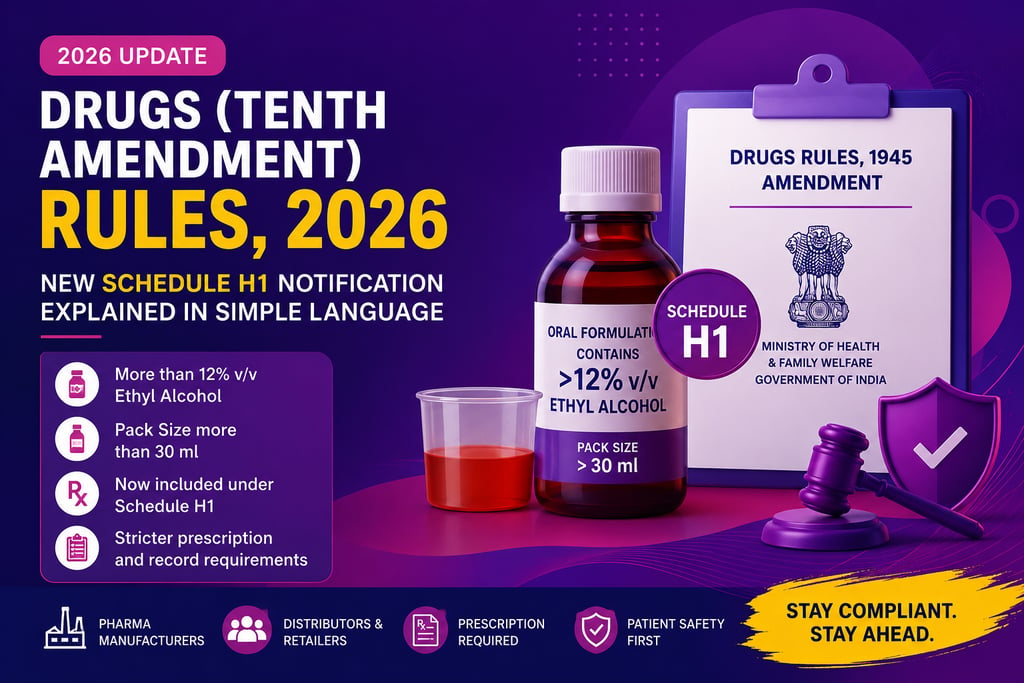
Drugs (Tenth Amendment) Rules, 2026: A Complete Guide for Pharmaceutical Manufacturers and Healthcare Businesses
The Indian pharmaceutical industry continues to evolve through regular regulatory updates that aim to improve patient safety, ensure responsible medicine use, and strengthen compliance across the supply chain. One such important regulatory change is the
Drugs (Tenth Amendment) Rules, 2026, notified by the Ministry of Health & Family Welfare, Government of India on 8 July 2026.
This notification introduces a significant amendment to the Drugs Rules, 1945 by bringing certain oral pharmaceutical formulations containing high levels of ethyl alcohol under Schedule H1. Although the amendment is concise, its impact extends to pharmaceutical manufacturers, third-party manufacturing companies, marketers, distributors, wholesalers, retailers, hospitals, and pharmacies.
For companies engaged in pharma third-party manufacturing, understanding this notification is essential to ensure regulatory compliance, packaging updates, proper documentation, and smooth business operations before the rules become effective.
At Ogiso Life Sciences Pvt. Ltd., we believe that keeping our customers informed about important regulatory developments is just as important as delivering high-quality pharmaceutical manufacturing services. In this article, we explain the notification in simple language and discuss its practical implications for the pharmaceutical industry.
Overview of the Gazette Notification
On 8 July 2026, the Ministry of Health & Family Welfare published G.S.R. 607(E) under the Drugs (Tenth Amendment) Rules, 2026. The amendment was issued after the draft notification published in October 2025 received no public objections or suggestions during the consultation period. Following consultation with the Drugs Technical Advisory Board (DTAB), the Central Government finalized the amendment, which will become effective six months after its publication in the Official Gazette.
The primary objective of this amendment is to regulate the sale of certain oral formulations containing a high percentage of ethyl alcohol by including them under Schedule H1 of the Drugs Rules, 1945.
What Has Changed?
The amendment introduces two important changes:
1. Amendment to Schedule K
Previously, certain products enjoyed exemptions under Schedule K. Under the new amendment, oral formulations containing more than 12% v/v Ethyl Alcohol packed in bottles larger than 30 ml are excluded from these exemptions.
2. New Entry Added to Schedule H1
A new Entry No. 52 has been inserted in Schedule H1 covering:
All oral formulations containing more than 12% alcohol (Ethyl Alcohol) by volume, packed and sold in bottles or packs exceeding 30 ml.
This means that these products will now be subject to the legal requirements applicable to Schedule H1 medicines.
Understanding Schedule H1 in Simple Language
Many people are familiar with Schedule H medicines, but Schedule H1 has additional controls.
Medicines listed under Schedule H1 require:
Sale only against a valid prescription issued by a Registered Medical Practitioner (RMP).
Maintenance of a separate Schedule H1 sales register by retailers.
Recording details such as the patient's name, doctor's name, quantity supplied, and date of sale.
Proper labeling in accordance with the Drugs Rules.
The purpose of Schedule H1 is to ensure that medicines with a higher potential for misuse are dispensed responsibly under medical supervision.
Which Products Are Covered?
The amendment does not apply to all medicines containing alcohol. It only applies when both of the following conditions are met:
Requirement Condition Alcohol Content More than 12% v/v Ethyl Alcohol Pack Size More than 30 ml
Only products meeting both conditions are included under the new Schedule H1 entry.
Which Products Are Not Covered?
The following products are not affected by this notification:
Oral medicines containing 12% or less Ethyl Alcohol
Oral medicines packed in 30 ml or smaller bottles, even if they contain more than 12% alcohol (unless regulated under another provision)
Non-oral dosage forms
Manufacturers should nevertheless review individual formulations carefully to determine whether they fall within the scope of the amendment.
Why Did the Government Introduce This Amendment?
Although the Gazette does not provide a detailed explanation, the amendment is intended to strengthen regulatory oversight of oral formulations containing higher levels of ethyl alcohol.
The likely objectives include:
Promoting responsible dispensing practices.
Preventing misuse of alcohol-containing medicinal products.
Improving traceability through Schedule H1 record-keeping.
Strengthening patient safety.
Supporting better regulatory monitoring.
These measures align with the Government's broader efforts to improve pharmaceutical regulation and ensure the rational use of medicines.
What Does This Mean for Pharma Third-Party Manufacturing Companies?
For companies engaged in pharma third-party manufacturing, this amendment is more than a simple labeling update—it requires a review of product portfolios, manufacturing documentation, and customer communication.
Manufacturers should begin assessing:
Existing formulations containing ethyl alcohol.
Alcohol concentration in finished products.
Pack sizes currently marketed.
Label artwork and packaging requirements.
Regulatory documentation.
Distributor and retailer awareness.
Inventory transition planning before the six-month implementation period ends.
Companies that prepare early can minimize business disruptions and help their marketing partners remain compliant.
Impact of the New Schedule H1 Notification on the Pharmaceutical Industry
Why This Amendment Matters to the Pharmaceutical Industry
The Drugs (Tenth Amendment) Rules, 2026 is not just another regulatory update. It directly affects how certain alcohol-containing oral medicines are manufactured, labeled, distributed, prescribed, and sold in India.
For companies involved in pharma third-party manufacturing, understanding these changes well before the implementation date is essential. Since the notification will come into force six months after its publication, pharmaceutical companies have sufficient time to review their product portfolio and ensure compliance with the amended Drugs Rules.
Impact on Pharmaceutical Manufacturers
Manufacturers producing oral formulations containing more than 12% v/v Ethyl Alcohol in bottles larger than 30 ml should immediately begin reviewing their products.
Areas that require attention
Product Portfolio Review
Every manufacturer should identify products that meet both conditions:
Parameter Requirement Alcohol Content More than 12% v/v Pack Size More than 30 ml
Any formulation matching both conditions will require compliance with Schedule H1 after the amendment becomes effective.
Label Artwork Review
Schedule H1 medicines require specific labeling requirements.
Manufacturers should review:
Product labels
Cartons
Pack inserts
Marketing literature
to ensure compliance before commercial production.
Documentation Review
Manufacturers should update:
Master Formula Records
Product Specifications
Regulatory Documents
Batch Manufacturing Records
Batch Packing Records
Product Information Sheets
This ensures consistency across manufacturing and regulatory documentation.
Customer Communication
Third-party manufacturers should proactively inform their marketing partners about:
Products covered under the notification
New compliance requirements
Timeline for implementation
Label changes
Inventory planning
Early communication helps avoid confusion during implementation.
Impact on Pharma Third-Party Manufacturing Companies
For companies like Ogiso Life Sciences Pvt. Ltd., regulatory compliance is an important part of quality manufacturing.
The amendment highlights why businesses should choose experienced pharma third-party manufacturing partners that maintain:
WHO-GMP compliant facilities
Strong Quality Assurance systems
Regulatory documentation support
Updated manufacturing SOPs
Professional regulatory guidance
Reliable manufacturing partners help pharmaceutical marketers adapt quickly to regulatory changes.
Impact on Pharma Marketing Companies
Marketing companies should immediately review their product portfolio.
Questions they should ask include:
Do any of our products contain more than 12% Ethyl Alcohol?
Are they sold in bottles larger than 30 ml?
Will our labels require revision?
Have we informed our distributors?
Are retailers aware of the new requirements?
Early planning reduces the risk of supply chain disruptions.
Impact on Distributors and Stockists
Distributors should prepare by:
Identifying affected products
Informing retailers
Updating inventory records
Coordinating with manufacturers
Understanding Schedule H1 requirements
This will help maintain uninterrupted product availability after implementation.
Impact on Retail Pharmacies
Retail pharmacies will experience one of the biggest operational changes.
Once the amendment becomes effective, covered products must be sold according to Schedule H1 requirements.
Retailers should prepare by:
Maintaining a Schedule H1 Register
Recording prescription details
Training pharmacy staff
Reviewing existing inventory
Purchasing only compliant stock
Failure to maintain Schedule H1 records may result in regulatory action during inspections.
Impact on Doctors
Registered Medical Practitioners should be aware that applicable products will now fall under Schedule H1.
This ensures:
Better prescription monitoring
Responsible dispensing
Improved patient safety
Better traceability
Impact on Patients
For patients, the amendment mainly means:
Medicines covered by the notification may only be available on prescription.
Proper medical supervision will be required.
Better safeguards against misuse.
Patients using medicines as prescribed should experience minimal inconvenience.
Compliance Checklist for Manufacturers
Every pharmaceutical manufacturer should complete the following checklist before the rules become effective.
Compliance Activity Status Identify Affected products Review alcohol percentage
Verify pack sizes
Update label artwork
Update regulatory documents
Review packaging material
Inform marketing companies
Train production team
Train QA department
Train dispatch team
Inform distributors
Prepare implementation timeline
How WHO-GMP Manufacturers Can Add Value
A WHO-GMP certified manufacturer offers much more than manufacturing capacity.
Companies like Ogiso Life Sciences Pvt. Ltd. provide:
Regulatory Documentation Support
Helping marketing companies update:
Product specifications
Labels
Technical documentation
Certificates
Manufacturing records
Artwork Assistance
Manufacturers can support customers by updating:
Cartons
Labels
Product inserts
Regulatory warnings
Quality Assurance
A strong QA team ensures that every batch complies with:
WHO-GMP Guidelines
Drugs Rules, 1945
Product Specifications
Customer Requirements
Regulatory Readiness
Professional manufacturers continuously monitor:
CDSCO updates
Gazette notifications
Drug Rules amendments
Quality standards
This allows marketing companies to stay compliant without constantly monitoring every regulatory development themselves.
Why Choosing the Right Pharma Third-Party Manufacturing Partner Matters
Today's pharmaceutical industry is highly regulated.
Choosing a manufacturing partner should not depend only on pricing.
Instead, businesses should evaluate:
✅ WHO-GMP Certification
✅ Regulatory Support
✅ Quality Systems
✅ Documentation
✅ Timely Delivery
✅ Experienced Technical Team
✅ Transparent Communication
A reliable manufacturing partner protects your business from regulatory risks while helping you grow confidently.
How Ogiso Life Sciences Pvt. Ltd. Supports Regulatory Compliance
At Ogiso Life Sciences Pvt. Ltd., compliance is integrated into every stage of manufacturing.
Our strengths include:
WHO-GMP Certified Manufacturing Facility
Systematic Quality Management
Advanced Quality Control Laboratory
Regulatory-Ready Documentation
Complete Dossier Support
Experienced Technical Team
Reliable Production Planning
Timely Delivery
Customer-Centric Manufacturing Solutions
Whether you are launching a new product or expanding your pharmaceutical portfolio, our team is committed to helping you navigate regulatory changes with confidence.
Frequently Asked Questions (FAQs)
1. What is the Drugs (Tenth Amendment) Rules, 2026?
The Drugs (Tenth Amendment) Rules, 2026 is a notification issued by the Ministry of Health & Family Welfare, Government of India on 8 July 2026. It amends the Drugs Rules, 1945 by bringing certain alcohol-containing oral formulations under Schedule H1. The rules will become effective six months after their publication in the Official Gazette.
2. Which medicines are covered under this notification?
The notification applies only to oral pharmaceutical formulations that satisfy both of the following conditions:
Contain more than 12% v/v Ethyl Alcohol
Are packed and sold in bottles or packs larger than 30 ml
3. Are all alcohol-containing syrups affected?
No.
Products containing 12% or less Ethyl Alcohol are not covered by this amendment.
Similarly, products packed in 30 ml or smaller bottles are not covered by this specific notification.
4. When will the amendment become effective?
The notification was published on 8 July 2026 and will become effective six months after publication in the Official Gazette.
5. Will manufacturers have enough time to comply?
Yes.
The Government has intentionally provided a six-month transition period so manufacturers, marketers, distributors, and pharmacies can prepare for implementation.
6. Will these medicines become banned?
No.
This notification does not ban the manufacture or sale of these medicines. Instead, it changes the regulatory category for eligible products by including them under Schedule H1, which introduces additional controls on how they are prescribed and sold.
7. What should pharmaceutical manufacturers do now?
Manufacturers should:
Review product formulations.
Verify alcohol concentration.
Check pack sizes.
Update labels if required.
Inform marketing companies.
Update regulatory documentation.
Train internal teams.
Prepare implementation plans before the effective date.
8. How does this affect pharma third-party manufacturing?
Companies offering pharma third-party manufacturing should evaluate whether any products manufactured for clients fall within the scope of the amendment and assist their partners with documentation, artwork updates, and compliance planning.
9. Why is WHO-GMP manufacturing important during regulatory changes?
WHO-GMP-certified manufacturers follow standardized quality systems, maintain comprehensive documentation, and regularly update their processes to align with regulatory requirements. This makes it easier for clients to adapt to changes such as the Drugs (Tenth Amendment) Rules, 2026.
Common Misconceptions About This Notification
❌ Myth 1: Alcohol-containing medicines are banned.
Fact: The notification does not ban alcohol-containing medicines. It only changes the regulatory requirements for certain products meeting specific alcohol concentration and pack size criteria.
❌ Myth 2: Every cough syrup will become Schedule H1.
Fact: Only oral formulations that contain more than 12% v/v Ethyl Alcohol and are sold in packs larger than 30 ml are covered by this amendment.
❌ Myth 3: The rules apply immediately.
Fact: The amendment becomes effective six months after publication, giving the industry time to prepare.
Why Regulatory Awareness Matters
The pharmaceutical industry is one of the most highly regulated industries in the world. Regulatory changes may appear small on paper, but they can have significant implications for manufacturing, packaging, distribution, marketing, and retail operations.
Staying informed helps pharmaceutical companies:
Reduce compliance risks.
Avoid regulatory observations.
Improve supply chain planning.
Build customer confidence.
Protect brand reputation.
Maintain uninterrupted business operations.
Companies that monitor regulatory developments and implement changes proactively are better positioned for sustainable growth.
Why Partner with Ogiso Life Sciences Pvt. Ltd.?
At Ogiso Life Sciences Pvt. Ltd., we understand that successful pharmaceutical manufacturing extends beyond production. It requires strong quality systems, regulatory awareness, and a commitment to compliance.
Our capabilities include:
WHO-GMP Certified Manufacturing Facility
Pharma Third-Party Manufacturing
Contract Manufacturing
Private Label Manufacturing
Tablets
Capsules
Oral Liquids
Suspensions
Ointments & Creams
Nutraceutical Manufacturing
Ayurvedic Manufacturing
Quality Assurance & Quality Control
Regulatory-Ready Dossier Support
Custom Packaging & Branding
Timely Delivery Across India
Whether you are launching a new pharmaceutical brand or expanding your existing portfolio, our experienced team is committed to providing high-quality manufacturing solutions backed by robust quality and regulatory systems.
Final Thoughts
The Drugs (Tenth Amendment) Rules, 2026 represent an important regulatory update aimed at improving oversight of certain oral pharmaceutical formulations containing higher levels of ethyl alcohol. While the amendment introduces additional compliance requirements for specific products, it also provides a six-month transition period, allowing manufacturers, marketers, distributors, and retailers adequate time to prepare.
For businesses involved in pharma third-party manufacturing, this is an opportunity to review product portfolios, strengthen regulatory documentation, update labeling where necessary, and ensure full compliance before the rules come into effect.
By partnering with a reliable WHO-GMP-certified pharmaceutical manufacturer like Ogiso Life Sciences Pvt. Ltd., pharmaceutical companies can confidently navigate regulatory changes while maintaining quality, compliance, and operational efficiency.
Suggested Internal Links
Official External References
For readers who wish to verify the notification or learn more about the applicable regulations, the following official resources may be useful:
Ministry of Health & Family Welfare (MoHFW): https://main.mohfw.gov.in
CDSCO (Central Drugs Standard Control Organization): https://cdsco.gov.in
Gazette of India (gazette): https://egazette.gov.in/
Department of Pharmaceuticals: https://pharma-dept.gov.in
Disclaimer
This article is intended for educational and informational purposes only. It is based on the Drugs (Tenth Amendment) Rules, 2026 (G.S.R. 607(E)) issued by the Ministry of Health & Family Welfare, Government of India, and explains the regulatory amendment in simplified language. While every effort has been made to ensure accuracy, this article should not be considered legal, regulatory, or professional advice.
Readers are advised to refer to the official Gazette Notification, the Drugs and Cosmetics Act, 1940, the Drugs Rules, 1945, and any subsequent amendments or official clarifications before making manufacturing, marketing, distribution, or compliance decisions. Regulatory requirements may change over time, and the applicability of the notification should be assessed on a product-specific basis.
The information provided does not replace consultation with qualified regulatory, legal, or pharmaceutical professionals. Ogiso Life Sciences Pvt. Ltd. and the author shall not be responsible for any loss, liability, or consequences arising from reliance on this article or any interpretation of the notification.
Author:
Mr. JP Sharma
Director – Ogiso Life Sciences Pvt. Ltd.
22+ Years of Experience in Pharmaceutical Manufacturing and Trading
With over two decades of experience in pharmaceutical manufacturing, contract manufacturing, regulatory compliance, and business development, Mr. JP Sharma regularly shares practical insights on pharmaceutical regulations, industry trends, third-party manufacturing, and quality systems to help pharmaceutical companies make informed business decisions.
Ogiso Lifesciences Pvt. Ltd.
© 2026 Ogiso Lifesciences Pvt. Ltd. | Third Party Pharma Manufacturing Company | Contract Manufacturing Company in India | All Rights Reserved.
Sitemap
Global Sourcing
ogisolifesciences@gmail.com
+91 9258152671
G,116 Riico Industrial Area Growth Center Dholpur Rajasthan- 328001
© 2026 Ogiso Lifesciences-WHO-GMP Certified third-party manufacturing Company.
ZERO-COMPROMISE COMPLIANCE