Leading Pharma Third Party Manufacturer

DPCO Amendment 2026: Simple Guide & Impact
Understand the DPCO Amendment 2026 in simple language. Discover how the new drug pricing rules affect pharmaceutical companies, third-party manufacturing, and compliance in India.
PHARMACEUTICAL BUSINESS
jp sharma
7/6/20265 min read
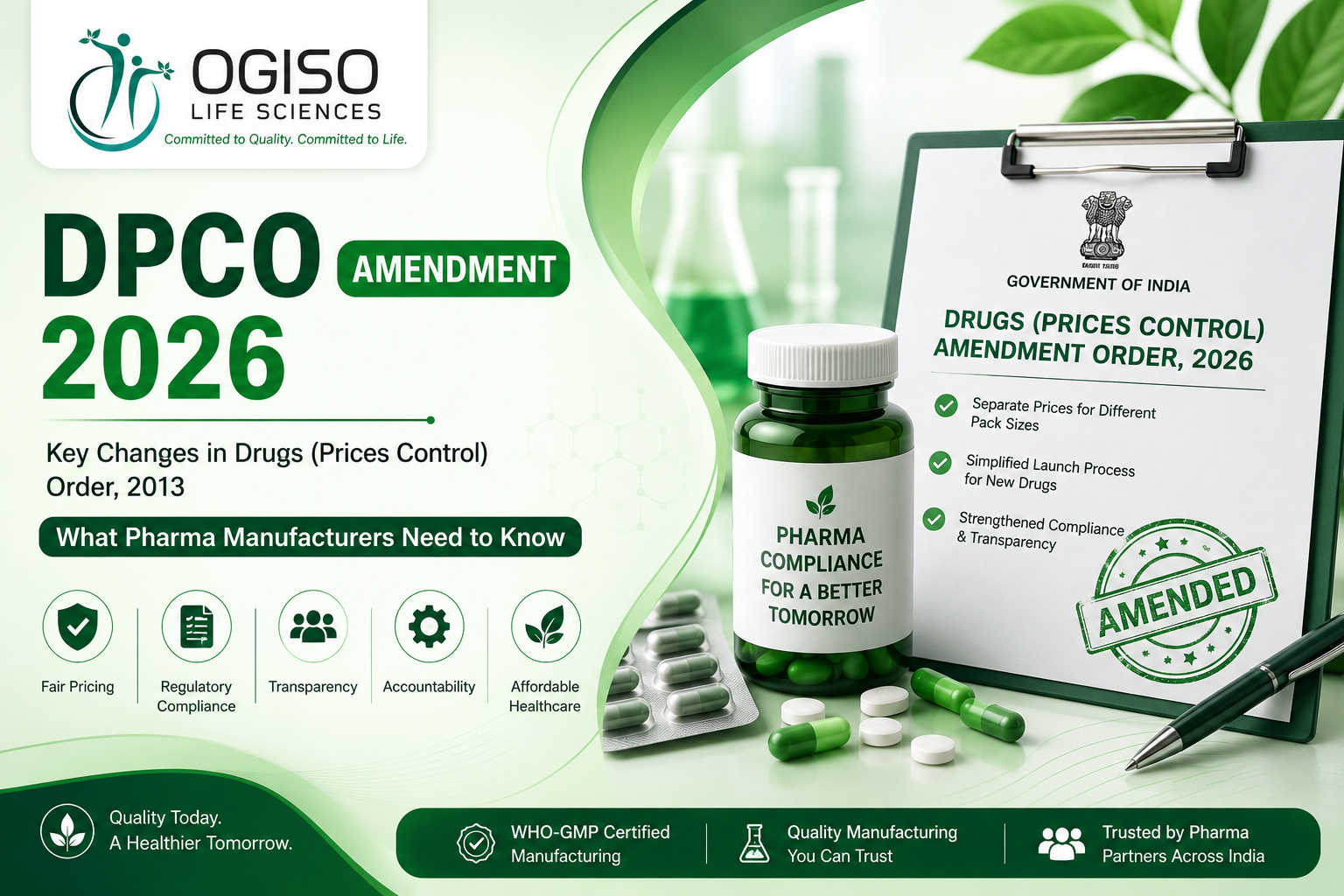
DPCO Amendment 2026 Explained: What Every Pharma Third-Party Manufacturing Company Must Know.
The Government of India has introduced the Drugs (Prices Control) Amendment Order, 2026 to improve transparency, simplify pricing procedures, and strengthen compliance under the Drugs (Prices Control) Order (DPCO), 2013.
This amendment, issued on 30 June 2026 by the Department of Pharmaceuticals (DoP) under the Ministry of Chemicals & Fertilizers, affects pharmaceutical manufacturers, importers, marketers, distributors, and businesses engaged in pharma third-party manufacturing.
If your company manufactures medicines for other brands or markets pharmaceutical products in India, understanding this amendment is essential.
In this article, we explain the order in simple language and discuss what it means for your pharmaceutical business.
What is DPCO?
The Drugs (Prices Control) Order (DPCO) is a regulation issued by the Government of India under the Essential Commodities Act, 1955.
Its primary objective is to:
Keep essential medicines affordable.
Prevent overpricing.
Ensure transparency in pharmaceutical pricing.
Protect consumers from unfair pricing practices.
The National Pharmaceutical Pricing Authority (NPPA) implements these regulations.
Why Was the DPCO Amendment 2026 Introduced?
Over the years, pharmaceutical companies have faced several practical challenges while implementing Government-notified prices.
Some common issues included:
Different pack sizes requiring different pricing.
Delay in communicating revised prices.
Duplicate applications for identical products.
Unclear responsibility for overcharging by distributors.
Lack of standardized launch reporting.
The Government has introduced this amendment to simplify these issues while ensuring better compliance.
Major Changes Introduced in DPCO Amendment 2026
Let's understand each amendment in simple language.
1. Separate Prices Can Now Be Fixed for Different Pack Sizes
Earlier, one ceiling price generally applied to a medicine.
Now the Government can notify different prices for the same medicine depending on:
Pack size
Packaging type
Dosage form
Liquid or gas formulations
Therapeutic requirements
Why is this important?
Different packaging often increases manufacturing costs.
This amendment allows more practical and fair pricing.
2. Manufacturers Get Protection from Unfair Overcharging Claims
Previously, manufacturers could be held responsible for overcharging even when distributors or retailers failed to follow revised prices.
Now, if the manufacturer can prove that they:
informed distributors,
circulated revised price lists,
issued updated notifications,
complied with DPCO requirements,
their liability will generally be limited to the stock actually found being sold above the notified price.
This is a major relief for genuine pharmaceutical manufacturers.
3. Easier Launch Process for Existing Manufacturers
Suppose Company A launches a new scheduled drug.
If another manufacturer launches the same product within 12 months, they no longer need to submit a fresh retail price application.
Instead, they simply need to inform the Government using the newly introduced Form IA within one month of launch.
This reduces paperwork and speeds up market entry.
4. Stricter Rules Against Overcharging
The amendment also strengthens enforcement.
If a manufacturer sells a scheduled formulation above the Government-notified retail price, they may have to:
Refund the excess amount.
Pay interest.
Face additional penalties under DPCO.
This reinforces the Government's commitment to protecting consumers from excessive drug pricing.
5. Manufacturers Must Publicly Announce Price Changes
One of the biggest changes is the communication requirement.
Whenever Government-notified prices change, manufacturers should make reasonable efforts to inform everyone involved.
This includes:
Sending revised price lists to distributors and retailers.
Publishing price reduction notices in at least two national newspapers.
Updating the company website.
Issuing revised Forms V or VI.
Maintaining batch-wise stock information.
These measures improve transparency across the supply chain.
6. Better Record Keeping Is Now Mandatory
Manufacturers must maintain records for at least seven financial years.
These records include:
API sales
Bulk drug sales
Formulation sales
Production records
Pack-wise details
Other records required by Government
If any investigation is ongoing, records must be preserved until the case is closed.
7. Introduction of Form IA
A completely new reporting format called Form IA has been introduced.
Manufacturers launching a new drug must provide information including:
Product name
Manufacturer details
Marketing company
Composition
Launch date
Pack size
Therapeutic category
Launch price
Government-notified price
This creates better transparency for new launches.
What Does This Mean for Pharma Third-Party Manufacturing Companies?
The amendment has significant implications for companies involved in pharma third-party manufacturing.
Better Regulatory Clarity
Third-party manufacturers now have clearer pricing procedures.
Faster Product Launches
Manufacturers producing identical scheduled formulations can enter the market faster without unnecessary approvals.
Stronger Documentation
Manufacturers should maintain:
Production records
Batch records
Price notifications
Communication records
Distributor acknowledgements
Good documentation helps avoid future disputes.
Improved Client Confidence
Marketing companies increasingly prefer manufacturing partners that maintain strong regulatory compliance.
A compliant pharma third-party manufacturing company is more attractive to pharmaceutical brands.
How Should Pharmaceutical Companies Prepare?
To comply with the amendment, pharmaceutical companies should:
Review all DPCO-covered products.
Update internal pricing procedures.
Train regulatory teams.
Maintain digital documentation.
Preserve records for seven years.
Inform distributors immediately after any price revision.
Update company websites with revised prices where applicable.
Why This Amendment Is Good for the Pharmaceutical Industry
Although the amendment introduces additional compliance requirements, it also provides several advantages.
These include:
Greater pricing transparency.
Simplified launch procedures.
Reduced unnecessary litigation.
Better consumer protection.
Faster compliance.
Improved trust in pharmaceutical manufacturers.
Overall, the amendment creates a more balanced pricing system for both industry and consumers.
Why Regulatory Compliance Matters in Pharma Third-Party Manufacturing
Regulatory compliance is no longer optional.
Companies involved in pharma third-party manufacturing should regularly monitor updates from:
Department of Pharmaceuticals
NPPA
CDSCO
Ministry of Chemicals & Fertilizers
Remaining compliant helps businesses avoid:
Penalties
Product pricing disputes
Regulatory notices
Financial liabilities
Business interruptions
How Ogiso Life Sciences Pvt. Ltd. Supports Regulatory Compliance
At Ogiso Life Sciences Pvt. Ltd., compliance is an integral part of our manufacturing operations.
Our team continuously monitors updates from NPPA, CDSCO, and the Department of Pharmaceuticals to ensure that products manufactured under our pharma third-party manufacturing services comply with applicable pricing and regulatory requirements.
From formulation development to commercial manufacturing, we emphasize quality, documentation, transparency, and timely regulatory compliance so our partners can focus on growing their pharmaceutical businesses with confidence.
Conclusion
The Drugs (Prices Control) Amendment Order, 2026 is an important regulatory update that simplifies pricing procedures while strengthening accountability across the pharmaceutical industry.
For companies involved in pharma third-party manufacturing, this amendment offers clearer pricing rules, easier product launches, improved legal protection, and stronger compliance mechanisms.
Pharmaceutical companies that invest in proper documentation, transparent pricing, and regulatory compliance will be better positioned for sustainable growth in the evolving Indian pharmaceutical market.
Frequently Asked Questions (FAQs)
When did the DPCO Amendment 2026 come into effect?
The amendment came into effect on 30 June 2026, the date of its publication in the Official Gazette.
Who is affected by this amendment?
The amendment applies to pharmaceutical manufacturers, importers, marketers, distributors, and pharma third-party manufacturing companies dealing with scheduled formulations.
What is Form IA?
Form IA is a newly introduced reporting format for notifying the Government about the launch of certain new drugs covered under the amended DPCO provisions.
How long must manufacturers maintain records?
Manufacturers must maintain prescribed records for at least seven financial years, or longer if any proceedings under the DPCO are pending.
Useful Links:
Contract Manufacturing Services
WHO-GMP Manufacturing Facility
Product Portfolio
Regulatory Compliance
Useful External Links (Authority Sources) Click Here To Download order copy
For readers who want to verify the notification and understand the regulatory framework, refer to these official resources:
Department of Pharmaceuticals (DoP): https://pharma-dept.gov.in
National Pharmaceutical Pricing Authority (NPPA): https://nppa.gov.in
Gazette of India (Official Notifications): https://egazette.gov.in/
Central Drugs Standard Control Organization (CDSCO): https://cdsco.gov.in
Disclaimer
This article is intended for educational and informational purposes only. It is based on the Drugs (Prices Control) Amendment Order, 2026 (Gazette Notification S.O. 3516(E), dated 30 June 2026) issued by the Government of India.
While every effort has been made to present accurate and up-to-date information, pharmaceutical laws, pricing regulations, and government notifications may be amended, superseded, or interpreted differently over time. Readers are strongly advised to refer to the official Gazette Notification and consult the Department of Pharmaceuticals (DoP), National Pharmaceutical Pricing Authority (NPPA), or qualified legal and regulatory professionals before making any manufacturing, pricing, marketing, or compliance-related decisions.
The explanations provided in this article are simplified for easier understanding and should not be considered legal, regulatory, or professional advice.
Ogiso Life Sciences Pvt. Ltd., its management, employees, affiliates, and the author shall not be be held responsible for any direct or indirect loss, liability, or business decision arising from reliance on the information contained in this article.
Author
Mr. JP Sharma
22+ years of experience in pharmaceutical manufacturing and trading.
Ogiso Lifesciences Pvt. Ltd.
© 2026 Ogiso Lifesciences Pvt. Ltd. | Third Party Pharma Manufacturing Company | Contract Manufacturing Company in India | All Rights Reserved.
Sitemap
Global Sourcing
ogisolifesciences@gmail.com
+91 9258152671
G,116 Riico Industrial Area Growth Center Dholpur Rajasthan- 328001
© 2026 Ogiso Lifesciences-WHO-GMP Certified third-party manufacturing Company.
ZERO-COMPROMISE COMPLIANCE